
The History of Topkapi Palace: A Historic Landmark Near The Irish Corner Pub
Istanbul is a city where history is part of everyday life. From ancient Byzantine monuments to magnificent Ottoman buildings, the Historic Peninsula offers visitors the opportunity to experience centuries of history within a relatively small area.
For visitors staying in or exploring Sultanahmet, one of the most important historical landmarks to discover is Topkapi Palace.
Located close to The Irish Corner Pub in the historic Sultanahmet and Cankurtaran area, Topkapi Palace is one of Istanbul’s most important historical attractions and a fascinating place to discover the history of the Ottoman Empire.
In this article, as part of our series about historical places near The Irish Corner Pub, we explore the history, architecture and cultural importance of Topkapi Palace.
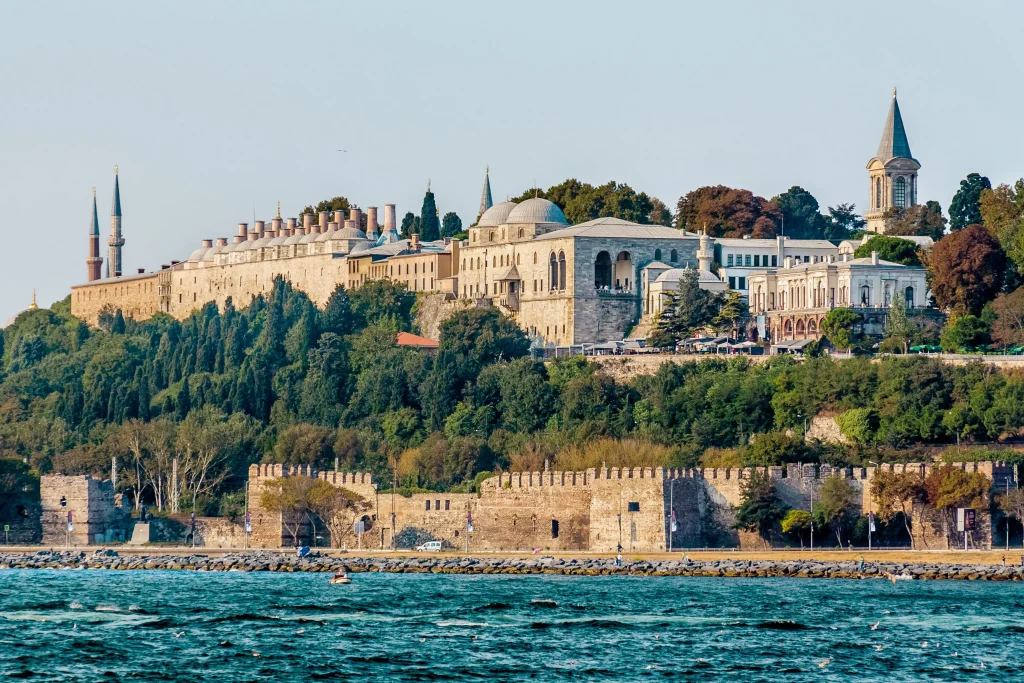
Where Is Topkapi Palace?
Topkapi Palace is located in the Fatih district of Istanbul, on the historic Sarayburnu peninsula.
The palace occupies a remarkable position overlooking the Bosphorus, the Sea of Marmara and the Golden Horn. Its location also places it close to some of Istanbul’s most famous landmarks, including Hagia Sophia, the Blue Mosque, Gülhane Park and the Basilica Cistern.
According to Türkiye’s National Palaces Administration, Topkapi Palace was built on the site of the ancient Byzantine acropolis at Sarayburnu. The original palace complex covered approximately 700,000 square metres, while the area excluding Gülhane Park covers around 350,000 square metres today.
This unique location makes Topkapi Palace an important stop for anyone looking for historical places to visit in Istanbul.
When Was Topkapi Palace Built?
The history of Topkapi Palace begins shortly after the Ottoman conquest of Constantinople.
After Sultan Mehmed II, also known as Mehmed the Conqueror, conquered Constantinople in 1453, Istanbul became the capital of the Ottoman Empire.
Mehmed II ordered the construction of a new imperial palace in Istanbul. According to the National Palaces Administration, the main construction of Topkapi Palace took place between 1460 and 1478.
The palace was subsequently expanded, renovated and modified by different Ottoman sultans over several centuries.
As a result, Topkapi Palace should not be considered a single building constructed during one period. Instead, it is a large palace complex that reflects different stages of Ottoman history.
Topkapi Palace and the Ottoman Empire
Topkapi Palace played a central role in the Ottoman Empire for approximately four centuries.
It served as an imperial residence as well as a major centre of government, education, administration and art.
According to the National Palaces Administration, Topkapi Palace remained the main imperial residence and an important administrative and cultural centre until the reign of Sultan Abdülmecid I, when the imperial court gradually moved to Dolmabahçe Palace.
For centuries, important decisions concerning the Ottoman Empire were made within the palace complex.
Sultans, members of the imperial family, statesmen, scholars, artists and palace officials all played a role in the daily life of Topkapi Palace.
This makes the palace one of the best places in Istanbul to understand the political and cultural history of the Ottoman Empire.
The Four Courtyards of Topkapi Palace
One of the most interesting features of Topkapi Palace is that it is not simply one enormous palace building.
The complex developed around a series of courtyards, each serving different purposes.
The First Courtyard
The First Courtyard was the outermost section of the palace and provided access from the city into the imperial complex.
Visitors today enter the historic palace grounds through the monumental Imperial Gate, or Bab-ı Hümayun.
This area provides an introduction to the scale and importance of Topkapi Palace.
The Second Courtyard
The Second Courtyard was closely connected with the administration of the Ottoman Empire.
Important institutions, including the Imperial Council, or Divan-ı Hümayun, were located here.
The palace kitchens were also situated in this area.
The Second Courtyard therefore gives visitors an insight into how the Ottoman imperial administration and palace life operated.
The Third Courtyard
The Third Courtyard was known as the Enderun Courtyard.
It contained several important areas associated with the inner palace, including the Audience Chamber and other sections connected with palace education and administration.
The Third Courtyard also contains the Holy Relics section, one of the most significant parts of Topkapi Palace.
The Holy Relics at Topkapi Palace
One of the reasons Topkapi Palace is particularly important is its collection of Sacred Relics, also known as the Holy Relics.
These religiously significant objects were brought to Istanbul during the Ottoman period and preserved within the palace.
The collection is associated with the Chamber of the Holy Mantle and includes important Islamic relics.
For visitors interested in Islamic history, Ottoman history and the cultural heritage of Istanbul, this section of Topkapi Palace is one of the most significant areas to explore.
The Harem of Topkapi Palace
The Harem is perhaps the most famous section of Topkapi Palace among international visitors.
The Harem was the private area of the imperial household. It contained numerous rooms, courtyards, corridors and chambers used by members of the imperial family and palace residents.
The architecture of the Harem provides a fascinating insight into private life within the Ottoman imperial court.
Decorative tiles, courtyards, chambers and architectural details reveal a very different side of Ottoman palace life compared with the official administrative areas.
Today, the Harem is one of the most popular sections of Topkapi Palace for visitors.
The Fourth Courtyard and the Bosphorus Views
The Fourth Courtyard contains several elegant pavilions and gardens.
Among the most famous structures are the Baghdad Pavilion, Revan Pavilion and the Iftar Pavilion.
This part of the palace is also particularly attractive because of its views.
Standing in the gardens of Topkapi Palace, visitors can look across the Bosphorus and the Sea of Marmara while surrounded by historic Ottoman architecture.
The combination of architecture, gardens and panoramic views makes this one of the most memorable parts of a visit to Topkapi Palace.
The Treasures of Topkapi Palace
Topkapi Palace is also famous for its rich collections.
Visitors can discover Ottoman-era objects, ceremonial items, weapons, manuscripts, artworks and valuable treasures.
The palace also preserves a significant historical archive. According to the Istanbul Governorship, Topkapi Palace contains important Ottoman collections and approximately 300,000 archival documents.
These collections help historians and visitors understand the political, artistic and cultural development of the Ottoman Empire.
Why Did the Ottoman Court Leave Topkapi Palace?
By the 19th century, the Ottoman Empire was changing rapidly.
The requirements of the imperial court and state administration had also changed, and Topkapi Palace was increasingly considered less suitable for the ceremonial and administrative needs of the modernising Ottoman state.
Dolmabahçe Palace was constructed between 1843 and 1856.
During the reign of Sultan Abdülmecid I, the imperial court moved from Topkapi Palace to Dolmabahçe Palace.
However, Topkapi Palace continued to retain important functions. The imperial treasury, Holy Relics and imperial archives remained associated with the palace.
When Did Topkapi Palace Become a Museum?
Topkapi Palace entered a new chapter in its history during the early years of the Turkish Republic.
On 3 April 1924, Topkapi Palace was transformed into a museum.
It became the first museum of the Republic of Türkiye and opened its historic collections to the public.
Today, Topkapi Palace is one of Istanbul’s most important museums and one of the city’s most visited historical attractions.
Topkapi Palace Near The Irish Corner Pub
One of the advantages of staying or dining in the Sultanahmet area is the proximity of many major historical attractions.
The Irish Corner Pub is located on Akbıyık Street in the Cankurtaran area, within Istanbul’s Historic Peninsula.
From the pub, visitors can continue their exploration of the surrounding historic district and discover some of Istanbul’s most important landmarks.
Topkapi Palace is particularly worthwhile for visitors interested in Ottoman history, imperial architecture and Istanbul’s cultural heritage.
A visit to the palace can easily be combined with other attractions in the area, including:
- Hagia Sophia
- Blue Mosque
- Basilica Cistern
- Gülhane Park
- Istanbul Archaeological Museums
- Sultanahmet Square
This makes the area around The Irish Corner Pub an excellent starting point for discovering the historical heart of Istanbul.
Why Should You Visit Topkapi Palace?
There are many reasons why Topkapi Palace should be included in an Istanbul itinerary.
It was the imperial residence of Ottoman sultans for approximately four centuries, served as an important centre of government and culture, and preserves some of the most valuable historical collections in Istanbul.
Visitors can explore Ottoman courtyards, palace chambers, the Harem, the Holy Relics, imperial treasures and beautiful gardens.
Perhaps most importantly, Topkapi Palace allows visitors to experience history while standing in the very place where many important events of the Ottoman era took place.
Discover Istanbul’s History from The Irish Corner Pub
A visit to Istanbul is much more than seeing famous monuments and taking photographs.
Walking through the Historic Peninsula allows visitors to understand how the city developed over centuries and how the Byzantine and Ottoman periods shaped modern Istanbul.
For guests visiting The Irish Corner Pub, Topkapi Palace is one of the most important historical attractions to discover nearby.
After enjoying time at the pub, visitors can continue towards Sultanahmet and explore one of the most impressive imperial palace complexes in the world.
From the courtyards of Topkapi Palace to the views of the Bosphorus, from the Harem to the Sacred Relics, every section tells another chapter of Istanbul’s remarkable history.
The Irish Corner Pub Historical Places Series
This article is part of our Historical Places Near The Irish Corner Pub series.
In future articles, we will continue exploring the fascinating historical landmarks surrounding The Irish Corner Pub and the Sultanahmet area.
If you are planning a trip to Istanbul, make sure to include Topkapi Palace on your list of historical places to visit.